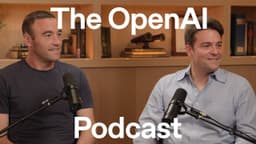
How AI Is Accelerating Scientific Discovery Today and What's Ahead
AI is beginning to change how science gets done. Head of OpenAI for Science Kevin Weil and OpenAI research scientist Alex Lupsasca talk about the early signs of acceleration researchers are seeing with GPT-5—from surfacing literature across fields and languages, to speeding up complex calculations, to designing follow-up experiments. They unpack what’s possible today, what doesn’t work yet, and why the next few years could reshape the trajectory of scientific progress across physics, math, biology and beyond.
🔬 What is the OpenAI for Science Initiative and its mission?
Accelerating Scientific Discovery Through AI
OpenAI for Science represents a dedicated initiative with an ambitious mission: to help scientists accomplish 25 years of research and discovery in just 5 years instead.
Core Mission:
- Primary Goal: Accelerate the pace of scientific research and discovery
- Method: Deploy OpenAI's most advanced models into the hands of leading scientists worldwide
- Foundation: Science underpins virtually everything in our lives and society
Why This Timing Matters:
- Novel Capability Emergence - GPT-5 is beginning to prove new things that humans haven't done before
- Frontier Breakthrough - AI models are starting to push past the boundaries of existing human knowledge
- Acceleration Pattern - Following OpenAI's typical progression from "can't do something" to "essential tool" within 6-12 months
Current Evidence of Impact:
- Real acceleration visible for scientists already using AI tools
- Small but genuine breakthroughs happening across multiple fields
- Early existence proofs of AI venturing into unknown scientific territory
⚡ How is AI currently accelerating scientific research across different fields?
Multi-Domain Scientific Applications
AI is demonstrating practical acceleration across the entire spectrum of scientific disciplines, from theoretical physics to biological research.
Fields Experiencing AI Acceleration:
- Mathematics - Novel proofs and complex calculations
- Physics - Theoretical problem-solving and equation derivation
- Astronomy - Data analysis and pattern recognition
- Life Sciences/Biology - Research acceleration and discovery
Types of Scientific Acceleration:
1. Parallel Exploration Capability
- Instead of exploring 2 research paths over a week
- Scientists can now explore 10 paths simultaneously in an hour
- Dramatically expands the scope of testable ideas
2. Advanced Literature Search
- Conceptual-level searches beyond simple keyword matching
- Cross-disciplinary discovery of related work
- Language barrier elimination - finding relevant research in foreign languages
- Terminology translation - connecting concepts across different fields
3. Computational Problem-Solving
- Complex mathematical derivations and special function manipulation
- Identification of obscure mathematical identities from historical literature
- Faster resolution of partial differential equations
🌟What was Alex Lupsasca's breakthrough experience with AI in physics?
From AI Skeptic to Believer Through Black Hole Research
Alex Lupsasca's transformation from AI skeptic to advocate happened through a specific breakthrough involving pulsar magnetic field calculations.
The Initial Skepticism:
- Started 2025 viewing ChatGPT as just a useful chatbot
- Used AI primarily for writing assistance and proofreading
- Believed it would take years before AI could handle specialized physics work
- Maintained skeptical stance, preferring evidence-based conviction
The Breakthrough Moment:
The Problem:
- Needed to find magnetic field solution around a pulsar (rotating star with powerful magnetic fields)
- Required solving a complex partial differential equation
- Solution involved infinite sum over products of Legendre polynomials
- Suspected there was a simpler formula the sum evaluated to
The AI Solution Process:
- Extended Thinking Time - ChatGPT o1 Pro thought for 11 minutes (unprecedented for his experience)
- Problem Decomposition - AI understood the mathematical structure and broke it into manageable pieces
- Historical Research Discovery - Found a specialized mathematical identity from a 1950s paper in a Norwegian Journal of Mathematics
- Near-Perfect Execution - Delivered beautiful derivation with only a minor typo (extra factor)
The Realization:
- Recognized this as a "uniquely human ability" he thought made theoretical physicists special
- Easy verification process confirmed the AI's work was fundamentally correct
- Marked the moment he realized AI had achieved capabilities he considered "amazing"
🔍How does AI perform cross-disciplinary literature discovery?
Revolutionary Research Discovery Beyond Traditional Methods
AI demonstrates remarkable ability to find relevant research across different fields, languages, and terminologies that traditional keyword searches would never locate.
The Cross-Disciplinary Discovery Example:
The Research Challenge:
- Researcher working on high-dimensional optimization
- Convinced someone must have worked on similar ideas before
- Traditional literature searches yielded no results
- Felt certain he couldn't be the first to explore this concept
AI's Discovery Process:
- Conceptual Understanding - GPT-5 analyzed the research description at a conceptual level
- Cross-Field Recognition - Identified related work in economics (completely different field)
- Terminology Translation - Connected concepts despite different academic vocabularies
- Language Barrier Breakthrough - Located relevant PhD thesis written in German
- Historical Recovery - Found work that was "basically lost to time"
AI's Unique Advantages:
- Conceptual-level literature search rather than keyword matching
- Multi-language capability for global research access
- Cross-disciplinary pattern recognition connecting disparate fields
- Historical document recovery of forgotten but relevant work
Personal Experience Confirmation:
Alex Lupsasca experienced identical breakthrough when researching black hole properties:
- Derived equation with unusual three-derivative term
- Recognized it as Schwarzschild derivative from mathematics
- AI immediately identified it as the conformal bridge equation
- Provided specific paper reference for further research
💎 Summary from [0:00-7:58]
Essential Insights:
- OpenAI for Science Initiative - Ambitious mission to compress 25 years of scientific research into 5 years by deploying advanced AI models to leading scientists worldwide
- Perfect Timing Convergence - GPT-5 is reaching the threshold where it can prove new things and venture beyond existing human knowledge frontiers
- Multi-Domain Acceleration - AI is demonstrating practical impact across mathematics, physics, astronomy, and life sciences through various acceleration mechanisms
Actionable Insights:
- Parallel Research Exploration - Scientists can now test 10 research paths simultaneously in an hour instead of 2 paths over a week
- Cross-Disciplinary Literature Discovery - AI performs conceptual-level searches across fields, languages, and terminologies that traditional methods miss
- Complex Problem-Solving Capability - AI can handle specialized calculations involving advanced mathematics, historical research, and obscure academic identities
Transformation Pattern:
- Rapid Adoption Curve - OpenAI's consistent pattern: from "can't do something" to "essential tool" within 6-12 months
- Skeptic to Advocate Journey - Even domain experts are experiencing breakthrough moments that fundamentally change their perception of AI capabilities
- Evidence-Based Conviction - Real examples of small but genuine breakthroughs are building confidence in AI's scientific potential
📚References from [0:00-7:58]
People Mentioned:
- Kevin Weil - Head of OpenAI for Science, leading the initiative to accelerate scientific discovery through AI
- Alex Lupsasca - OpenAI research scientist and professor of physics at Vanderbilt University, specializing in black hole physics
- Andrew Mayne - General Partner at Zero Shot Fund, podcast host
Companies & Products:
- OpenAI - AI research company developing GPT models for scientific applications
- ChatGPT o1 Pro - Advanced AI model capable of extended reasoning (11+ minutes thinking time)
- Vanderbilt University - Academic institution where Alex Lupsasca serves as physics professor
Technologies & Tools:
- GPT-5 - Frontier AI model demonstrating novel scientific proof capabilities
- ChatGPT - AI assistant being used for scientific research acceleration
- Partial Differential Equations - Mathematical tools for describing physical phenomena around pulsars
Concepts & Frameworks:
- Legendre Polynomials - Special mathematical functions used in physics calculations
- Schwarzschild Derivative - Mathematical concept appearing in black hole physics
- Conformal Bridge Equation - Mathematical framework connecting different areas of physics
- High-Dimensional Optimization - Mathematical field with cross-disciplinary applications
- Pulsar Magnetic Fields - Astrophysical phenomena involving rotating stars with powerful magnetic fields
Publications:
- Norwegian Journal of Mathematics (1950s) - Historical publication containing specialized mathematical identity
- German PhD Thesis - Cross-disciplinary economics research relevant to optimization problems
🔍How does GPT help researchers discover connections across scientific fields?
Cross-Disciplinary Literature Discovery
The Challenge of Specialization:
- Extreme Niche Focus - Modern research requires such deep specialization that researchers struggle to stay current with neighboring fields
- Missed Connections - Equations and discoveries from one field often have applications in others, but these connections go unnoticed
- Time Constraints - Exploring adjacent areas would take too long without AI assistance
GPT as a Research Collaborator:
- Universal Knowledge Base - Has read virtually every scientific paper across all disciplines
- Pattern Recognition - Can identify when work in one field relates to discoveries in another
- Instant Expertise - Provides expert-level knowledge on any topic without the years of study typically required
Real-World Impact:
- Researchers can now explore adjacencies they previously couldn't afford to investigate
- Bidirectional Benefits: Helps scientists go both deeper in their specialty and broader across disciplines
- Enables meaningful collaboration across field boundaries that were previously too difficult to bridge
📚What scientific discoveries were delayed by poor literature search capabilities?
Historical Examples of Delayed Innovation
Famous Cases of Missed Connections:
Carbon Filaments for Light Bulbs - Thomas Edison spent enormous effort searching for the right material, but it had been published 20 years earlier (Dewey Decimal System was invented that same year, making search nearly impossible)
Silicon Semiconductors - Could have been developed 5-10 years earlier if researchers had better access to existing literature
DNA Replication Techniques - The ability to replicate DNA had been published 10-12 years before someone finally connected the dots
DNA Shotgun Sequencing - First published in 1982, but wasn't utilized until supercomputers became available to run the computations
The Modern Solution:
- AI-Powered Search - Can instantly surface relevant research across decades of publications
- Cross-Language Capabilities - Finds connections in papers published in different languages
- Pattern Matching - Identifies relationships that human researchers might miss due to different terminology or contexts
Why This Matters:
The most interesting research now happens at intersections of multiple fields, but it's nearly impossible for one person to be an expert in several domains simultaneously.
🤝How does GPT-5 solve the collaboration challenges in scientific research?
AI as the Perfect Research Partner
Traditional Collaboration Limitations:
- Expertise Gaps - Hard to find the right collaborator with complementary knowledge
- Human Constraints - Limited patience, availability, and working hours
- Interdisciplinary Barriers - Difficulty bridging knowledge between 3-5 different fields
GPT-5 as a Collaborator:
- 24/7 Availability - Works around the clock without fatigue
- Infinite Patience - Will engage with questions and iterations indefinitely
- Universal Expertise - Has comprehensive knowledge across virtually all scientific disciplines
- Consistent Quality - Maintains high-level analysis regardless of time or complexity
The Acceleration Effect:
- New Form of Collaboration - Represents an entirely different way of conducting research
- Intersection Research - Enables work at the crossroads of multiple fields where the most interesting discoveries happen
- Democratized Access - Gives every researcher access to expert-level knowledge in adjacent fields
Historical Context:
Even legendary collaborations like Claude Shannon working with his mathematician wife demonstrate how much scientific progress depends on having the right intellectual partnerships.
🚀What convinced Kevin Weil that GPT-5 could revolutionize scientific research?
The Lawrence Livermore Fusion Physics Demo
The Unexpected Meeting:
Kevin Weil went to meet physicist Brian Spears expecting to pitch AI capabilities, but instead got completely blown away by what the researcher was already accomplishing with O1 Preview.
The Progressive Complexity Test:
- Undergraduate Level - Copper rod bombarded with high-pressure waves - GPT got it right
- Graduate Level - Internal rod dynamics and shock wave generation requirements - Correct again
- Postdoc Level - Advanced nuclear physics applications - Still accurate
- New Lawrence Livermore Researcher - Professional-level fusion physics - Continued success
- 20-Year Veteran Level - Expert-level analysis that suggested using partially classified simulation tools only available at the lab
The Game-Changing Realization:
- Time Compression - Tasks that would take Spears days were completed in minutes
- Accessibility - Not everyone at the lab could solve these problems, but GPT could
- Future Implications - This was O1 Preview a year ago; current models are significantly more advanced
The Paradigm Shift:
"These are the worst AI models that we will ever use for the rest of our lives" - meaning the acceleration in scientific capability will only continue to increase exponentially.
🧠What made Alex Lupsasca become "AI pilled" about scientific research?
The Black Hole Symmetry Challenge
The Setup:
Alex met Mark Chen (OpenAI's Chief Research Officer) who challenged him to give GPT a truly difficult problem to test its capabilities.
The Test Case:
- Recent Discovery - Alex had just discovered new symmetries of black holes (a rare occurrence in physics)
- Published Research - His paper had come out in June on the archive
- The Challenge - He gave GPT just the equation without any leading questions or hints
- Simple Query - Asked only "What are the symmetries?" without revealing that symmetries existed
The Surprising Result:
- Extended Processing - GPT thought for five minutes (indicating deep analysis)
- Unexpected Answer - Concluded "no symmetries"
- The Twist - This response actually demonstrated sophisticated understanding, as finding symmetries in black hole physics is extremely complex
Why This Matters:
This experience convinced Alex that AI could engage with cutting-edge, unpublished research at a level that impressed even the researcher who made the original discovery.
Career Impact:
This demonstration was significant enough to influence Alex's decision to join OpenAI, showing the profound potential he saw in AI for advancing scientific research.
💎 Summary from [8:05-15:57]
Essential Insights:
- Cross-Field Discovery - GPT excels at finding connections between research in different scientific disciplines, solving the problem of extreme specialization
- Historical Acceleration - Many scientific breakthroughs were delayed by decades due to poor literature search capabilities, a problem AI can now solve
- Perfect Collaboration - AI provides 24/7 availability, infinite patience, and expertise across all fields - qualities impossible to find in human collaborators
Actionable Insights:
- Researchers can now explore adjacent fields they previously couldn't afford to investigate due to time constraints
- AI enables work at the intersection of multiple disciplines where the most interesting discoveries happen
- Current AI models represent the "worst" we'll ever use, meaning scientific acceleration will continue exponentially
📚References from [8:05-15:57]
People Mentioned:
- Thomas Edison - Referenced for his extensive search for carbon filament materials that had already been published
- Claude Shannon - Information theory pioneer whose mathematician wife contributed to his collaborative success
- Brian Spears - Physicist at Lawrence Livermore National Laboratory who demonstrated GPT's fusion physics capabilities
- Mark Chen - Chief Research Officer at OpenAI who challenged Alex with the black hole symmetry problem
Companies & Products:
- Lawrence Livermore National Laboratory - First to achieve large-scale fusion with positive energy, where Brian Spears conducts research
- OpenAI - Developer of GPT models being used for scientific research acceleration
Technologies & Tools:
- GPT-5 - Advanced AI model enabling cross-disciplinary research and literature discovery
- O1 Preview - Earlier OpenAI model that demonstrated sophisticated physics problem-solving capabilities
- Dewey Decimal System - Library classification system invented in Edison's era, highlighting historical search limitations
Concepts & Frameworks:
- Cross-Disciplinary Research - Scientific work at the intersection of multiple fields where major breakthroughs occur
- Literature Search Acceleration - AI's ability to surface relevant research across languages and decades of publications
- Black Hole Symmetries - Advanced physics concept in Alex's research on gravitational phenomena
🧠How did GPT-5 solve a complex black hole physics problem that took years to master?
Alex's Breakthrough Moment with AI
The Challenge Setup:
- Initial Test - Alex gave GPT-5 a complex black hole symmetry problem he'd been working on for years
- First Failure - The model couldn't solve the full problem initially, leaving Mark Chen "visibly crestfallen"
- Strategic Pivot - Alex decided to try a simpler "warm-up baby version" of the same problem
The Breakthrough Process:
- Warm-up Problem: Find symmetries in flat space (empty space-time) instead of full black hole space-time
- First Success: After 9 minutes of thinking, GPT-5 correctly identified conformal symmetry with three generators
- The Real Test: Using the same chat session, they tried the original hard problem again
- Stunning Result: After 18 minutes of processing, the model produced a completely correct answer
Why This Was Revolutionary:
- Expert-Level Difficulty: Alex described this calculation as "at the edge of my abilities"
- Rare Expertise: "Very few people could have done the way I did it"
- Years of Training: The problem required specialized knowledge in finding symmetries of black holes
- Career-Defining Moment: This experience convinced Alex to join OpenAI's research team
Personal Impact:
- Left Alex "shell-shocked for a few days"
- Couldn't stop thinking about the implications
- Realized he had to become involved with AI development
- Described seeing this capability emerge as something he couldn't ignore
🎯Why do AI models fail at frontier problems and how can researchers work around this?
Understanding AI's Current Limitations in Scientific Research
The Reality of Frontier Research:
- High Failure Rate - AI models are often wrong when operating at the limit of their capabilities
- Human-Like Behavior - Similar to humans working at their expertise frontier
- Not Automatic Yet - Can't simply enter hard questions and expect immediate correct answers
The Low Pass Rate Challenge:
- Statistical Reality: Models might have only a 5% success rate on frontier problems
- User Experience Problem: Most people try 2-3 times, then give up
- Hidden Capability: The model can solve the problem, but requires persistence
- Differentiation Difficulty: Hard to distinguish between low pass rate vs. impossible problems
Successful Research Strategies:
Back-and-Forth Approach:
- Patience Required: Best researchers show willingness to iterate multiple times
- Collaborative Process: Treat the AI as a research partner, not a magic solution
- Refinement Method: Take correct parts and refine while correcting errors
The Warm-Up Strategy:
- Natural Progression: Start with simpler versions of the problem
- Human-Like Approach: Mirrors how human researchers actually tackle complex problems
- Priming Effect: Easier problems can help the model approach harder versions
OpenAI's Research Focus:
- Reducing Cognitive Load: Making the iteration process less burdensome
- Automation Goals: Helping researchers identify when persistence will pay off
- Interface Improvements: Better tools for managing multiple attempts and refinements
🚀What parallels exist between GPT-3.5 to ChatGPT evolution and current AI science tools?
The Prompt Engineering to User-Friendly Interface Evolution
Historical Context - The GPT-3.5 Era:
- Base Model Limitations: Extremely capable but required expert knowledge to use effectively
- Prompt Engineering Necessity: Success required understanding specific tricks and context manipulation
- Barrier to Entry: Only skilled practitioners could extract the model's full potential
The ChatGPT Transformation:
- Problem Understanding: OpenAI identified common user challenges and use cases
- Interface Revolution: Made powerful capabilities accessible without specialized knowledge
- Democratization: Removed the need for prompt engineering expertise
Current State of AI in Science:
Similar Pattern Emerging:
- Expert Knowledge Required: Researchers like Alex understand how to work with AI models effectively
- Iteration Expertise: Knowing when to persist, how to break down problems, and when to try different approaches
- Frontier Characteristics: Problems at the model's capability limit require sophisticated interaction strategies
Anticipated Evolution:
- Learning from Experts: Understanding how successful researchers interact with AI
- Interface Improvements: Making advanced techniques accessible to broader scientific community
- Acceleration Potential: Could see dramatic improvements as tools become more user-friendly
The Frontier Principle:
- Consistent Challenge: Whether GPT-3 or current models, frontier problems always have low pass rates
- Shifting Boundaries: What constitutes "frontier" has moved from basic tasks to scientific research
- Persistent Patterns: The need for persistence and iteration remains constant at capability edges
🌊 Why is the edge of knowledge "jagged" and how does this affect AI capabilities?
Understanding the Irregular Nature of Scientific Progress
The Jagged Edge of Human Knowledge:
Simple Questions, No Answers:
- Fundamental Mysteries: "Why are there three dimensions of space?"
- Cosmological Puzzles: "What happened at the Big Bang?"
- Universal Accessibility: Everyone wants answers to these basic questions
- Reality Check: "There's really nothing intelligent to say about this. We just don't know."
Complex Questions, Precise Answers:
- Quantum Precision: Can predict electron dipole moment to 12 decimal places
- Unexpected Mastery: Extremely detailed answers to seemingly impossible questions
- Counterintuitive Progress: Hard problems sometimes have complete solutions
Learning the Scientific Landscape:
- Graduate School Reality: "Takes many years of graduate school to learn where the edge is"
- Professional Development: Understanding what's known vs. unknown requires extensive training
- Research Strategy: Knowing where to focus efforts based on knowledge boundaries
AI's Parallel Jagged Edge:
Different Capability Patterns:
- Unique Strengths: AI models excel at some very hard problems today
- Surprising Gaps: Basic questions that models can't answer effectively
- Complementary Abilities: AI's knowledge edge is "jagged in a way that's different from ours"
Strategic Implications:
- Opportunity Identification: Finding where AI capabilities align with research needs
- Collaborative Potential: Human and AI knowledge gaps don't perfectly overlap
- Research Acceleration: AI can solve problems that are difficult for humans, and vice versa
The Warm-Up Strategy Validation:
- Natural Problem-Solving: The flat space approach was "the obvious place to start"
- Human-AI Alignment: Both humans and AI benefit from logical problem progression
- Future Improvements: Models could learn to identify their own warm-up problems
💎 Summary from [16:06-23:59]
Essential Insights:
- AI Breakthrough Moment - GPT-5 solved a complex black hole physics problem that took an expert years to master, but only after being "warmed up" with a simpler version
- Frontier Research Reality - AI models have low pass rates on cutting-edge problems, requiring patience and iteration rather than one-shot solutions
- Jagged Knowledge Edge - Both human and AI knowledge have irregular boundaries, with surprising gaps in basic areas and unexpected mastery in complex domains
Actionable Insights:
- Use warm-up problems to prime AI models before tackling complex research questions
- Expect multiple iterations when working at the frontier of AI capabilities - persistence often pays off
- Recognize that AI's knowledge gaps differ from human limitations, creating opportunities for complementary collaboration
- Understand that the most valuable AI applications may be in areas with low but non-zero pass rates
📚References from [16:06-23:59]
People Mentioned:
- Mark Chen - OpenAI researcher who was present during Alex's breakthrough moment with GPT-5, described as "visibly crestfallen" when the initial attempt failed
Concepts & Frameworks:
- Conformal Symmetry - Mathematical concept that GPT-5 correctly identified in the black hole physics problem
- Black Hole Space-time - Complex physics domain where Alex was working on symmetry problems
- Flat Space Limit - Simplified version of the physics problem used as a warm-up for the AI model
- Electron Dipole Moment - Quantum physics measurement that can be predicted to 12 decimal places, illustrating the jagged nature of scientific knowledge
- Pass Rate - Statistical measure of AI model success on frontier problems, often as low as 5%
🧠How is GPT-5 expanding AI capabilities beyond human limits?
AI-Human Collaboration at the Frontier
The evolution of AI capabilities creates fascinating dynamics at the intersection of human and artificial intelligence:
Expanding Capability Edges:
- Different Growth Trajectories: AI models expand their abilities in ways that differ from human cognitive development
- Intersection Points: The most interesting discoveries happen where AI can go farther than humans in some areas while humans still lead in others
- Collaborative Advantage: Human-AI partnerships prove significantly more powerful than either working alone
Strategic Implications:
- AI doesn't simply replace human capabilities but creates new collaborative possibilities
- The divergent paths of AI and human development create unique opportunities for breakthrough discoveries
- Future scientific progress will likely depend on leveraging these complementary strengths
📄 What does OpenAI's new GPT-5 science research paper reveal?
Comprehensive Multi-Field Analysis
OpenAI has compiled extensive evidence of GPT-5's scientific capabilities into a major research publication:
Paper Structure and Scope:
- 12 distinct sections highlighting different acceleration methods
- Collaborative effort with 8-9 external academics across multiple disciplines
- Fields covered: Mathematics, physics, astronomy, computer science, biology, materials science
- Transparent methodology: Full ChatGPT conversation links included for verification
Three-Tier Impact Analysis:
- Literature Search Enhancement - Improved research discovery and cross-field connections
- Calculation Acceleration - Faster computational work and analysis
- Novel Mathematical Results - 4-5 new non-trivial mathematical discoveries, some worthy of standalone papers
Research Philosophy:
- Balanced perspective: Clearly states what works and what doesn't work
- Moment-in-time snapshot: Acknowledges rapid evolution of capabilities
- Evidence-based approach: Focuses on documented examples rather than speculation
🎓 What advice do OpenAI scientists give to students worried about AI?
Embracing AI as a Powerful Research Tool
Current academic anxiety stems from broader systemic changes, not just AI advancement:
Current Academic Landscape:
- Existing challenges: Significant organizational changes in scientific institutions unrelated to AI
- Student concerns: Widespread anxiety about career prospects and relevance
- AI as solution: New tools can actually help address efficiency and productivity challenges
Practical Research Benefits:
- Path exploration: AI helps chart multiple research directions simultaneously
- Rapid prototyping: Test different approaches without major time investment
- Intelligent signposting: Get guidance on potential avenues before committing resources
Research Process Enhancement:
- Problem description: Upload notes or describe research goals in simple terms
- Approach testing: Ask "what if I approached it this way?" for multiple strategies
- Path mapping: Receive detailed roadmaps through unknown territory
- Efficiency gains: Save time on preliminary exploration and validation
Future Outlook:
- Young researchers already experimenting extensively with ChatGPT capabilities
- AI will make everyone faster and more productive rather than replacing scientists
- Tool mastery will become essential for competitive advantage
🔮How will AI transform scientific research in the next 12 months?
Rapid Evolution and Fundamental Changes
The pace of AI advancement makes long-term predictions challenging, but near-term changes are already visible:
Historical Context of Rapid Change:
- 12-month embarrassment cycle: Looking back just one year reveals dramatic capability gaps
- Turing Test milestone: A 75-year AI research goal passed without fanfare
- Software engineering transformation: Complete shift from manual coding to AI-assisted development in 2025
Immediate Scientific Impact (Next 12 Months):
- Theoretical sciences: Profound changes in physics, mathematics, and computer science research
- In silico capabilities: Enhanced computational and theoretical work
- Life sciences emergence: Beginning to see applications in biological research
- Physical sciences integration: Early adoption in experimental and applied physics
Transformation Indicators:
- Productivity revolution: Similar to how coding assistants became essential for engineers
- Methodology shifts: Fundamental changes in how research is conducted
- Accessibility improvements: Complex calculations and analysis becoming more approachable
Five-Year Uncertainty:
- Prediction difficulty increases exponentially with time horizon
- Current 12-month changes suggest unprecedented acceleration ahead
- Mathematical proof and theoretical work showing particular promise
💎 Summary from [24:05-31:51]
Essential Insights:
- AI-Human Synergy - The most powerful scientific discoveries emerge from collaborative partnerships where AI and human capabilities complement rather than compete
- Evidence-Based Progress - OpenAI's comprehensive research paper documents real acceleration across 12 scientific domains with transparent methodology and verifiable results
- Student Empowerment - Rather than threatening careers, AI tools are making young researchers more efficient by enabling rapid exploration of multiple research paths simultaneously
Actionable Insights:
- Students should embrace AI as a research accelerator that helps prototype ideas and explore multiple approaches without major time investment
- Scientists can leverage AI for literature search, calculation acceleration, and even breakthrough mathematical discoveries
- The next 12 months will bring fundamental changes to scientific methodology similar to how coding assistants transformed software engineering
📚References from [24:05-31:51]
People Mentioned:
- Demis Hassabis - CEO of Google DeepMind, recognized for contributions to AI in science including AlphaFold
Companies & Products:
- Google DeepMind - Acknowledged for pioneering work in AI for scientific discovery
- AlphaFold - Google's protein structure prediction system mentioned as exemplary AI science work
- GitHub Copilot - AI coding assistant referenced as transformative tool for software engineering
- Claude - Anthropic's AI assistant mentioned alongside other coding tools
Technologies & Tools:
- GPT-5 - OpenAI's latest model demonstrating scientific research capabilities across multiple domains
- ChatGPT - Practical research tool for path exploration and problem-solving assistance
Concepts & Frameworks:
- Turing Test - Historical AI benchmark that was surpassed without fanfare, illustrating rapid progress
- In silico research - Computational and theoretical scientific work enhanced by AI capabilities
- Human-AI collaboration - Emerging paradigm where combined capabilities exceed individual performance
🧬 How does AI help overcome bottlenecks in life sciences testing?
Drug Discovery and Search Space Optimization
The Challenge:
Life sciences face a fundamental bottleneck where AI can generate far more predictions than researchers can physically test in laboratories.
AI's Solution Approach:
- Intelligent Search Space Pruning - Models learn to eliminate unlikely candidates before expensive testing
- Targeted Drug Discovery - Focus resources on compounds most likely to succeed in specific scenarios
- Regulatory Process Acceleration - AI assists in writing comprehensive papers that compile research findings
Multi-Stage Benefits:
- Early Stage: Prune vast search spaces to identify promising drug candidates
- Development Phase: Guide more efficient experimental design and testing protocols
- Regulatory Stage: Streamline documentation and approval processes
- Real-World Impact: Faster path from discovery to consumer availability
Current Industry Adoption:
OpenAI has active pilots with multiple companies in the pharmaceutical and life sciences space, demonstrating broad-based applications across the drug development pipeline.
🚀Why will AGI's biggest impact come through scientific breakthroughs?
The Profound Path to AGI Experience
Personal Impact Predictions:
While ChatGPT serves as an incredible daily tool, the most transformative AGI experiences will emerge through scientific applications that directly change human lives.
Revolutionary Applications:
- Personalized Medicine - AI-driven treatments tailored to individual genetic profiles and conditions
- Scalable Fusion Energy - Accelerated development of clean, abundant energy solutions
- Advanced Materials Science - Discovery of new materials with unprecedented properties
Why Science Amplifies AGI Impact:
- Universal Benefit: Scientific breakthroughs affect entire populations, not just individual users
- Compound Effects: Each discovery enables further discoveries across multiple fields
- Real-World Transformation: Changes fundamental aspects of how humans live and work
Current Trajectory:
The pace of AI development makes these scientific applications very real possibilities, representing the most exciting frontier for AGI implementation.
🔬 What gap exists between AI capabilities and scientific adoption?
The Utilization Challenge
Current Reality Check:
Even with GPT-5 Pro (OpenAI's best publicly available model), there's a significant gap between what AI models can accomplish and how the scientific community actually uses them.
Two Fundamental Truths:
- Continuous Improvement - Models are definitively getting better, with internal OpenAI models showing even stronger capabilities
- Adoption Lag - Scientists aren't fully utilizing current model capabilities due to rapid pace of change
The Awareness Problem:
- Rapid Evolution: Models improve so quickly that users may not realize capabilities have changed in just a few months
- Outdated Perceptions: Scientists often base judgments on experiences from 6-18 months ago
- Version Confusion: Many users try free versions that lack the thinking time needed for complex problems
OpenAI for Science Mission:
Bridge this gap by helping the scientific community understand and leverage the true frontier of current AI capabilities, leading to accelerated adoption and scientific progress.
⏱️ How does extended thinking time transform AI problem-solving?
The Compute-Time Breakthrough
Current Thinking Capabilities:
GPT-5 Pro can think for up to 40 minutes on the hardest problems, but this represents just a fraction of its potential thinking capacity.
Extended Thinking Potential:
- 2-6 Hours: Models can maintain productive thinking for extended sessions
- 12-24 Hours: Capability exists for day-long problem-solving approaches
- Unlimited Scaling: No fundamental limit on thinking time, only current resource allocation constraints
Performance Correlation:
Pass rates on difficult problems continue to improve as models receive more thinking time, mirroring human problem-solving patterns.
Human Analogy:
Just as humans solve different problems given 20 minutes versus 2 hours versus a full day, AI models demonstrate similar scaling benefits with extended thinking time.
Scientific Application Strategy:
- Targeted Access: Provide scientists who understand model capabilities with substantial compute resources
- Quality over Quantity: Fewer users but with deeper, more powerful access
- Acceleration Multiplier: Combine expert knowledge with extended AI thinking time
🎯What scientific acceleration could happen with today's AI models?
The Immediate Opportunity
Current State Potential:
Even if AI model progress stopped today, significant scientific acceleration could occur through two key factors:
- Increased Awareness - Helping scientists understand current capabilities
- Better Access - Providing researchers with the best available model performance
The Reasoning Revolution:
The discovery that current models can solve more complex problems simply by thinking longer represents a paradigm shift in AI utilization without requiring new model architectures.
Hyperscale Computing Applications:
- Extended Problem-Solving: Use massive compute resources to let current models think for hours or days
- Complex Discovery Tasks: Apply extended reasoning to scientific problems that require deep, sustained analysis
- Resource Optimization: Focus computing power on high-impact scientific applications
Dual-Track Progress:
- Immediate Impact: Maximize current model capabilities through better utilization
- Future Enhancement: Continue advancing model capabilities while improving scientific adoption
Long-term Vision:
Combine extended thinking time, advanced model training on scientific tasks, and widespread scientific community adoption to create unprecedented research acceleration.
💎 Summary from [32:01-39:52]
Essential Insights:
- Life Sciences Bottleneck Solution - AI helps by intelligently pruning search spaces in drug discovery, making physical testing more efficient rather than creating overwhelming prediction volumes
- AGI's Scientific Impact - The most profound way people will experience AGI is through scientific breakthroughs like personalized medicine and scalable fusion energy, not just daily ChatGPT interactions
- Capability-Adoption Gap - A significant disconnect exists between what current AI models can do and how scientists actually use them, creating an immediate acceleration opportunity
Actionable Insights:
- Keep testing AI models on scientific problems every few months, even if previous attempts weren't helpful, due to rapid improvement cycles
- Focus on bridging the awareness gap between AI capabilities and scientific community adoption for immediate impact
- Leverage extended thinking time (hours to days) with current models to solve complex problems that require sustained reasoning
- Recognize that scientific acceleration can happen immediately with today's models through better utilization, independent of future AI advances
📚References from [32:01-39:52]
People Mentioned:
- Alex Lupsasca - OpenAI Research Scientist contributing insights on model capabilities and scientific applications
Companies & Products:
- OpenAI - Developing GPT-5 Pro and internal models with enhanced scientific capabilities
- ChatGPT - Daily-use AI tool mentioned as comparison point for AGI applications
Technologies & Tools:
- GPT-5 Pro - OpenAI's best publicly available model with extended thinking capabilities up to 40 minutes
- Internal OpenAI Models - Advanced models with even stronger capabilities than publicly available versions
Concepts & Frameworks:
- Search Space Pruning - AI methodology for eliminating unlikely candidates in drug discovery before expensive testing
- System One and System Two Thinking - Cognitive framework applied to AI reasoning, where extended thinking time improves problem-solving success rates
- AGI (Artificial General Intelligence) - Advanced AI systems that will have profound impact through scientific applications
- Reasoning Paradigm - Discovery that current models can solve more complex problems by thinking for extended periods
🚀What exciting scientific breakthroughs do OpenAI researchers hope AI will accelerate?
Future Scientific Frontiers
Personal Research Passions:
- Black Hole Physics - Alex Lupsasca's primary interest in using AI to accelerate black hole research and theoretical understanding
- Fusion Energy - Kevin Weil's focus on scaling fusion technology for global energy transformation
- Dark Matter Research - Exploring AI's potential to integrate disparate experimental data and theories
AI's Role in Theoretical Breakthroughs:
- Knowledge Integration - AI could combine vast amounts of theoretical knowledge that human minds struggle to hold together
- Pattern Recognition - Identifying connections across different experimental datasets and theoretical frameworks
- Theory Validation - Using AI to rule out theories by combining disparate bits of knowledge about phenomena like dark matter
Experimental Applications:
- Better Experiment Design - AI could help design more effective and sophisticated experiments
- Complex Experiment Execution - Future potential for AI to run complicated experiments in various fields
- In Silico Research - Current focus on theoretical fields that can be explored computationally
📊How are AI models performing on advanced scientific benchmarks today?
Current Scientific Benchmark Performance
GPQA Benchmark Evolution:
- Original Performance (2021): GPT-4 scored 39% on Google Proof QA scientific questions
- Human Baseline: PhD-level scientists score approximately 70%
- Current Performance: Latest models achieve nearly 90% accuracy
- Significance: AI now surpasses most humans across multiple scientific fields simultaneously
Benchmark Progression Strategy:
- Adaptive Testing - As models improve, benchmarks must become more challenging
- Frontier Science Focus - New evaluations target cutting-edge scientific and mathematical questions
- Economic Value Assessment - GDP Val tests models' ability to perform economically valuable tasks
- Continuous Improvement - Every gap identified provides feedback for further model enhancement
Performance Implications:
- Models demonstrate cross-disciplinary expertise at PhD level across all scientific fields
- Rapid advancement from 39% to 90% in approximately two years
- Human-level surpassing performance in scientific reasoning tasks
- Need for harder benchmarks as current tests become insufficient measures
⚡ Why could fusion energy be the most transformative scientific breakthrough?
The Fusion Energy Opportunity
Current Status and Potential:
- Proof of Concept Exists - Small-scale demonstrations prove fusion is achievable
- Scaling Challenge - Need to achieve fusion at bigger scale and more reliably
- Inevitable Success - Technology will eventually be solved, question is timeline
- AI Acceleration - Potential for AI to significantly speed up development
World-Changing Impact:
- Energy Abundance - Orders of magnitude improvement in energy production
- Problem Solving - Many global challenges become solvable with unlimited clean energy
- Infrastructure Transformation - Enables massive computational infrastructure for AI development
- Economic Revolution - Fundamentally changes cost structures across all industries
Energy-Dependent Applications:
- Desalinization - Making ocean water drinkable becomes economically viable
- Construction - Energy-intensive building processes become cost-effective
- Manufacturing - All industrial processes benefit from cheap, abundant energy
- Technology Infrastructure - Supports massive GPU farms and computational needs
Historical Precedent:
- Order of Magnitude Changes - When something improves 10x, the world fundamentally changes
- Software Engineering Parallel - AI has already transformed coding from 30 million to potentially 3 billion capable programmers
- Energy Transformation - 10x cheaper, more prevalent energy would similarly revolutionize civilization
🌍What is OpenAI's philosophy for democratizing scientific discovery?
Bottom-Up Scientific Revolution
Core Philosophy:
- General Purpose AI - Focus on building the best general-purpose AI rather than dictating specific applications
- Scientist-Driven Innovation - Let researchers in each field determine how to use AI for their purposes
- Distributed Discovery - Breakthroughs will come from scientists worldwide, not centralized efforts
- Maximum Adoption - Goal is widespread adoption across all scientific disciplines
Strategic Approach:
- Release and Empower - Push AI tools out to the global scientific community
- Individual Passion Projects - Each researcher applies AI to their specific interests and expertise
- Unpredictable Innovation - Accept that the next breakthrough could come from anywhere
- Surface Area Maximization - The frontier of science is massive, requiring distributed effort
Implementation Vision:
- Hundred Nobel Prizes - Success measured by scientists worldwide winning recognition using AI
- Science 2.0 Moment - This represents a fundamental transformation, not the end of science
- Learning Through Participation - OpenAI will engage in some projects to learn, but majority of impact comes from external scientists
- Global Acceleration - Focus on giving all scientists worldwide access to AI tools
Research Reality:
- Unpredictable Breakthroughs - Impossible to predict where the next major discovery will emerge
- Field-Specific Expertise - Each scientist knows their domain best and can identify optimal AI applications
- Collaborative Enhancement - AI serves as a powerful collaborator and tool, not a replacement
- Beginning, Not End - This marks the start of accelerated scientific progress, not its conclusion
🔬 How should scientists approach integrating AI into their research?
Practical Integration Guidance
Core Message:
- Continue Current Work - Don't abandon existing research projects or career paths
- AI as Collaborator - View AI as a powerful new tool and research partner
- Enhanced Experience - AI will make research more engaging and bring new life to various fields
- Unique Historical Moment - This represents a special time in scientific history
Integration Strategy:
- Maintain Focus - Keep doing what you're already doing in your field
- Add AI Tools - Incorporate AI as an additional resource in your research toolkit
- Explore Possibilities - Experiment with how AI can enhance your specific research area
- Stay Curious - Approach AI integration with excitement about new possibilities
Expected Outcomes:
- Increased Engagement - Research becomes more fun and dynamic
- Field Revitalization - AI brings new energy to established scientific disciplines
- Enhanced Productivity - Accelerated progress without changing core research focus
- Collaborative Enhancement - AI serves as an intelligent research assistant
💎 Summary from [40:01-48:03]
Essential Insights:
- Benchmark Evolution - AI models have progressed from 39% to 90% on PhD-level scientific questions, surpassing human performance across multiple fields simultaneously
- Scientific Integration Philosophy - OpenAI advocates for bottom-up adoption where scientists worldwide use general-purpose AI tools for their specific research rather than top-down dictated applications
- Transformative Potential - Fusion energy and other breakthrough technologies could fundamentally change civilization when accelerated by AI, similar to how AI has already expanded software engineering capabilities from millions to billions of people
Actionable Insights:
- Scientists should continue their current research while incorporating AI as a powerful new collaborator and tool
- The next major scientific breakthroughs will likely come from distributed efforts by researchers worldwide using AI, not centralized projects
- Order-of-magnitude improvements in energy production could solve many global challenges and enable massive technological infrastructure development
📚References from [40:01-48:03]
Technologies & Tools:
- GPQA (Google Proof QA) - Scientific benchmark testing PhD-level questions across multiple scientific fields
- GDP Val - OpenAI evaluation testing models' ability to perform economically valuable tasks
- ChatGPT - Mentioned as a tool for integrating experimental data and theories in dark matter research
Concepts & Frameworks:
- Benchmark Saturation - The phenomenon where AI models master existing tests, requiring progressively harder evaluations
- In Silico Research - Computational research methods that can be performed entirely through computer simulation
- Science 2.0 - The concept of a fundamental transformation in how scientific research is conducted with AI assistance
Scientific Fields Referenced:
- Black Hole Physics - Alex Lupsasca's area of expertise and passion for AI acceleration
- Dark Matter Research - Field where AI could integrate disparate experimental data and theories
- Fusion Energy - Technology with potential for AI-accelerated development and global transformation
- Drug Discovery - Mentioned as an important application area for AI in scientific research